Spring comes to Sán Chay people

ĐBP - Ahead of the 2025 Lunar New Year (Tết) holiday, a visit to Huổi Thanh 1 Hamlet, Nậm Kè Commune, Mường Nhé District, reveals the changes of the Sán Chay ethnic minority people as their community gradually develops.

From a poor hamlet where Sán Chay people had struggled with daily hardships, the small hamlet has a new appearance. It now has fertile rice fields, lush cassava fields, and new stilt houses with bright smiles on the faces of the Sán Chay people who are busily preparing for a cozy and joyful new spring, reflect the profound changes in their lives.

Sán Chay women making traditional costume.

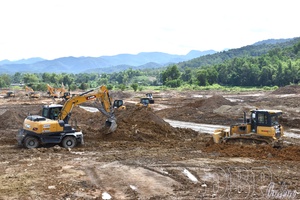
The road leading to Huổi Thanh 1 Hamlet, about 12 kilometers from the center of Nậm Kè Commune, has changed significantly. From a winding road which was dust in sunny days and mud in rainy days, it was recently concreted and widened, making transportation become safer and more convenient for local people.

According to Head of Huổi Thanh 1 Hamlet Đặng Văn Néng, the area is home to 98 families with 546 residents who are from three ethnic minority groups including 38 Sán Chay, 38 Dao, and 22 Mông households. Although the poverty rate is about 40%, the Sán Chay community here has fewer households living in poverty, most are classified as near-poor instead.

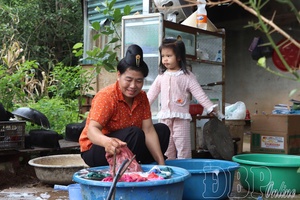
Sán Chay people in Huổi Thanh 1 clean their house for the Tết holiday.

Talking about the history of Huổi Thanh 1 Hamlet, Mr. Đặng Văn Néng explained that the Sán Chay people of Huổi Thanh 1 is originated from the Northeastern region in Bảo Lạc District, Cao Bằng Province. Back then, families were large, with each household typically having 6-7 siblings, while arable land was limited, making livelihoods difficult.

Knowing that making a living in Mường Tè (formerly part of Lai Châu Province, now in Mường Nhé District, Điện Biên Province) was easier than in their homeland, the elders decided to migrate. Initially, they settled in the area now known as Huổi Lụ 2 Hamlet, Pá Mỳ Commune, however, due to steep terrain, they moved to Huổi Thanh 1 in 2003. At that time, the hamlet had not yet established and there were a few households of Sán Chay and Dao ethnic minority people. Later, Mông people also joined them.

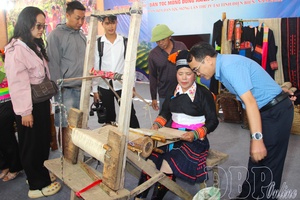
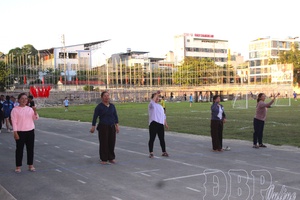
Preparing for a spring tour.

When arriving in the new land, they faced a number of challenges. This is a common fact: Starting from scratch. So do the Sán Chay people!

They began by building homes and clearing fields to cultivate rice. However, their lives was still unstable. They had find wild yams and vegetables in the forest with the hope that their new lives would gradually become more stable.

Mr. Đặng Văn Néng remembered: “At that time, it was not just the difficulties in living facing them. It was also the lack of healthcare service. Because of those struggles and shortages, it was only on special occasions as they invited the shaman for a ritual, each family got to enjoy the taste of chicken.”

After many years of benefiting from the Government’s projects, along with support from various levels and sectors in the province, the Sán Chay community in particular and Huổi Thanh 1 residents in general have learned new farming methods and diversified livelihoods, contributing to improving economic conditions.

Sán Chay women wear traditional costume to welcome the Lunar New Year.

“In recent years, the lives of the Sán Chay people have changed significantly. Our community has learned to cultivate wet rice, which yields much more than shifting cultivation, so hunger has almost been eradicated. Thanks to the care and support from the Party and State through various practical programs, living standards of local people in the hamlet have improved drastically. Makeshift and downgraded houses have decreased by 80%. In the past, they did not know much about farming techniques, but now they are growing cassava, cinnamon, acacia... Currently, the hamlet has nearly 100 hectares of cassava, supplying raw materials to local factories. Thanks to this, many households now earn from VNĐ 50 to 60 million annually, even VNĐ 70 million from cassava cultivation,” added Mr. Néng.

On the occasion of the 2025 Lunar New Year (Tết) holiday, local people are expected to enjoy a cozy and happy celebration.

Diệp Chi
Comment

You have 500/500 characters left

Please enter 5 or more characters!!!

Recent news

  • 'Boosting credit growth to serve socio-economic development

    Boosting credit growth to serve socio-economic development

    ECONOMY -
    ĐBP - Amid an environment where the socio-economic context continues to maintain positive growth momentum, the banking sector across Điện Biên province plays a crucial role in supplying financial resources for production, business, and development programs.
  • 'Mường Chà commune Police with “Digital Popular Education” movement

    Mường Chà commune Police with “Digital Popular Education” movement

    SOCIAL AFFAIRS -
    ĐBP - Currently, in Mường Chà commune, Điện Biên province, many elderly people have never used smartphones, and many remain unfamiliar with cashless payments. Therefore, Mường Chà commune police forces determined that achieving successful digital transformation requires first helping residents understand, know, and feel confident using technology.
  • 'Youths active in remote villages

    Youths active in remote villages

    SOCIAL AFFAIRS -
    ĐBP - Amid highland mountains and forests, the green color of volunteer shirts presence on hill fields, rural roads, social security activities, and journeys bringing digital transformation to every village.
  • 'Turning culture into a development resource

    Turning culture into a development resource

    CULTURE - SPORTS -
    ĐBP - Designating culture as a spiritual foundation and endogenous resource for sustainable development, Điện Biên province deployed numerous solutions to elevate the spiritual and cultural life of the people, preserving and promoting traditional values, through which cultural values spread deeply across the community, contributing to building a rich identity and developing image for Điện Biên.
  • 'Silent footsteps find martyrs’ remains

    Silent footsteps find martyrs’ remains

    NEWS - POLITICS -
    ĐBP - There are marches without gunfire, only silent footsteps tracing memories to find martyrs still lying behind. Amid the mist atop Pha Đin peak, the journey gathering 2 martyrs’ remains within the “500-day-and-night Campaign to boost searching, gathering, and identifying martyrs’ remains” represents a journey of gratitude, rediscovering names for fallen soldiers.
  • 'Điện Biên synchronously renovates park, greenery, and sidewalk system

    Điện Biên synchronously renovates park, greenery, and sidewalk system

    SOCIAL AFFAIRS -
    ĐBP - The system of parks, trees, and sidewalks plays a crucial role in creating landscapes, enhancing living quality, and forming a modern urban appearance. In Điện Biên province’s Điện Biên Phủ and Mường Thanh wards, despite serving as the provincial development core, the system of trees, parks, and landscape infrastructure exhibits numerous limitations requiring synchronous renovation under planning to satisfy green, smart, and sustainable urban construction requirements.
  • 'OCOP: Điện Biên’s tourism ambassadors

    OCOP: Điện Biên’s tourism ambassadors

    TRAVEL -
    ĐBP - After years of implementation, the One Commune One Product (OCOP) Program has encouraged many producers to improve product quality, refine production processes, build brands and expand markets. As tourism increasingly shifts toward deeper, experience-based development, integrating OCOP products into tourist experiences is seen as a way to create more sustainable added value for both products and destinations.
  • 'Keepers of ethnic groups’ cultural identities

    Keepers of ethnic groups’ cultural identities

    CULTURE - SPORTS -
    ĐBP - Điện Biên is home to 19 ethnic groups living together, with each community contributing to creating a colorful cultural mosaic. Through the flow of integration and development, those traditional values continue to be cherished, preserved, and handed down across generations.
  • 'Joining hands to collect martyrs’ relatives’ DNA samples

    Joining hands to collect martyrs’ relatives’ DNA samples

    SOCIAL AFFAIRS -
    ĐBP - Guided by the moral traditions of “When drinking water, remember its source” and “Repaying gratitude,” over recent days, police forces across Điện Biên province have been actively coordinating with functional units to boost collecting DNA samples from relatives of martyrs whose identities remain unconfirmed.
  • 'Developing tourism from culture

    Developing tourism from culture

    TRAVEL -
    ĐBP - Điện Biên is home to 19 ethnic groups with numerous distinct traditional cultural values in festivals, costumes, cuisine, and customs, with the entire province currently holding 24 national intangible cultural heritages alongside majestic natural landscapes, establishing major potential for Điện Biên to exploit and develop tourism.
  • 'Empowering women to tackle social challenges together

    Empowering women to tackle social challenges together

    SOCIAL AFFAIRS -
    ĐBP - The implementation of Project 938 on “Communication, education, advocacy and support for women to address social issues affecting women during the 2017-2027 period,” launched by the Prime Minister, has created a solid foundation for government agencies, sectors and the Women’s Union at all levels to play a leading role in addressing social issues from the grassroots.
  • 'Synchronously coordinating execution of 500-day-and-night campaign

    Synchronously coordinating execution of 500-day-and-night campaign

    NEWS - POLITICS -
    ĐBP - These days, alongside the entire country, at martyrs’ cemeteries across Điện Biên province, collecting martyrs’ remains samples to serve DNA testing is deployed urgently. Each collected biological sample demonstrates a spirit of responsibility, deep gratitude, and close synchronous coordination among sectors and forces during the execution of this sacred duty.
  • 'Listening to the people’s voices

    Listening to the people’s voices

    NEWS - POLITICS -
    ĐBP - Over a year of operating under the two-tier local governance model, the gap between party committees, local authorities, and residents has narrowed continuously. Voter contacts, dialogues, and field trips to the grassroots level by commune leaders have become occasions for residents to confide their thoughts and aspirations, thereby resolving difficulties and obstacles promptly.